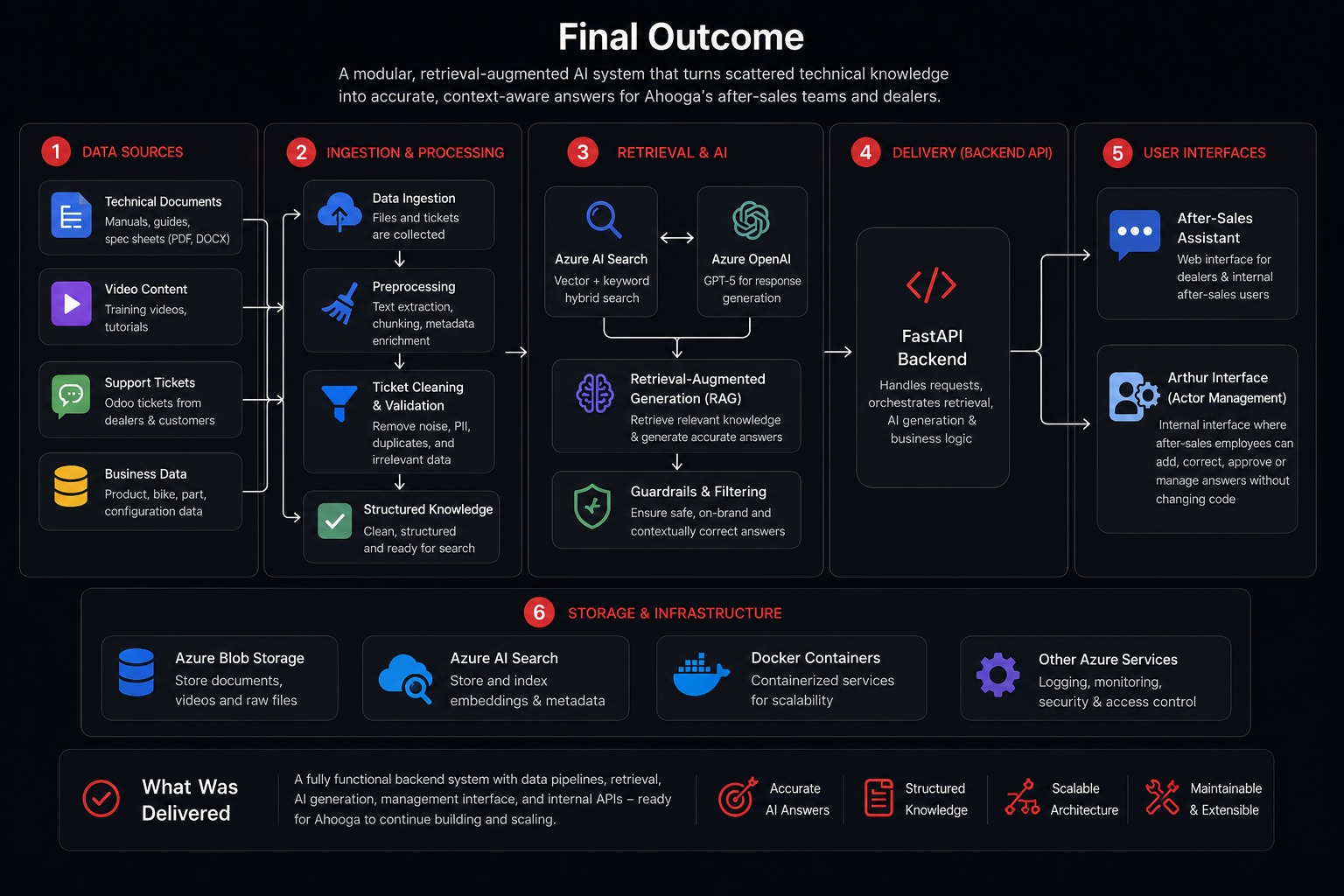
This project is part of my AI internship at Ahooga Bike, where I am designing and developing a complete AI-powered after-sales assistant system from scratch. The system is built to improve customer support and streamline internal processes by combining intelligent search, structured data retrieval, and AI-generated responses. Using a modern architecture with FastAPI, Azure OpenAI, and Azure AI Search, I implemented a Retrieval-Augmented Generation (RAG) pipeline that allows the assistant to retrieve relevant information from manuals, troubleshooting documents, and business data before generating accurate responses. This ensures the system provides reliable, context-aware support rather than generic AI answers. Due to company policy, a public live demo is not available.

Case Study (Coming Soon)
The goal of this internship project is to help improve Ahooga’s after-sales process by developing an AI-powered assistant that can support customer interactions and internal operations. The focus is on making support faster, more consistent, and more efficient by using intelligent chat-based solutions connected to structured business knowledge.
One of the main challenges is designing an AI solution that is both useful in a real business environment and aligned with company workflows. This includes working with structured knowledge sources, making responses relevant and reliable, and ensuring the assistant can support both customer-facing and internal use cases without exposing sensitive business information.
I designed a modular AI system for aftersales support, focused on delivering reliable, product-specific answers rather than generic chatbot responses. The architecture separates logic, retrieval, and data ingestion layers to maintain strict control over how answers are generated.
To eliminate hallucinations and ensure accuracy, I implemented a Retrieval-Augmented Generation (RAG) workflow. The system does not generate answers freely — it first retrieves validated technical content (manuals, troubleshooting guides, and structured ticket cases), then generates responses strictly based on that context.
A key challenge was handling noisy and unstructured support tickets. To address this, I introduced a preprocessing layer that extracts structured “cases” from raw tickets and prepares them for validation before ingestion. This prevents low-quality or irrelevant data from degrading AI performance.
The system is currently under active development and already demonstrates a working architecture combining FastAPI, Azure OpenAI, and Azure AI Search. Key components such as document ingestion, vector search, and AI response generation have been successfully implemented. This project has given me hands-on experience in building real-world AI systems, integrating external APIs, and designing scalable backend architectures for business use cases.